| Question | 1. Explain Circular flow of income in two sector economy. |
| Class | Class 12 |
| Subject | Economics (Macroeconomics) |
| Category | Sandeep garg Macroeconomics Class 12 Solutions |
Sandeep Garg Macroeconomics Class 12 Solutions Circular flow of Income – Short Questions – Q.1 Explain Circular flow of income in two sector economy.
“OR”
Explain the circular flow of income.
TWO SECTORAL Economy or SIMPLE Economy assumes only two sectors: Household and Firms.
Some of the assumptions that are taken for better understanding of this system are:-
- There are only two sectors in an economy i.e. households and firms.
- Household sector provides factor services to the firms and makes consumption expenditure on goods and services produced by the firms.
- Firms produce goods and services and make factor payments (rent, wages, interest, profit) to household sector for their factor services (land, labor, capital, entrepreneur).
- There are no savings in the economy by the household sector which means all income is spent on consumption.
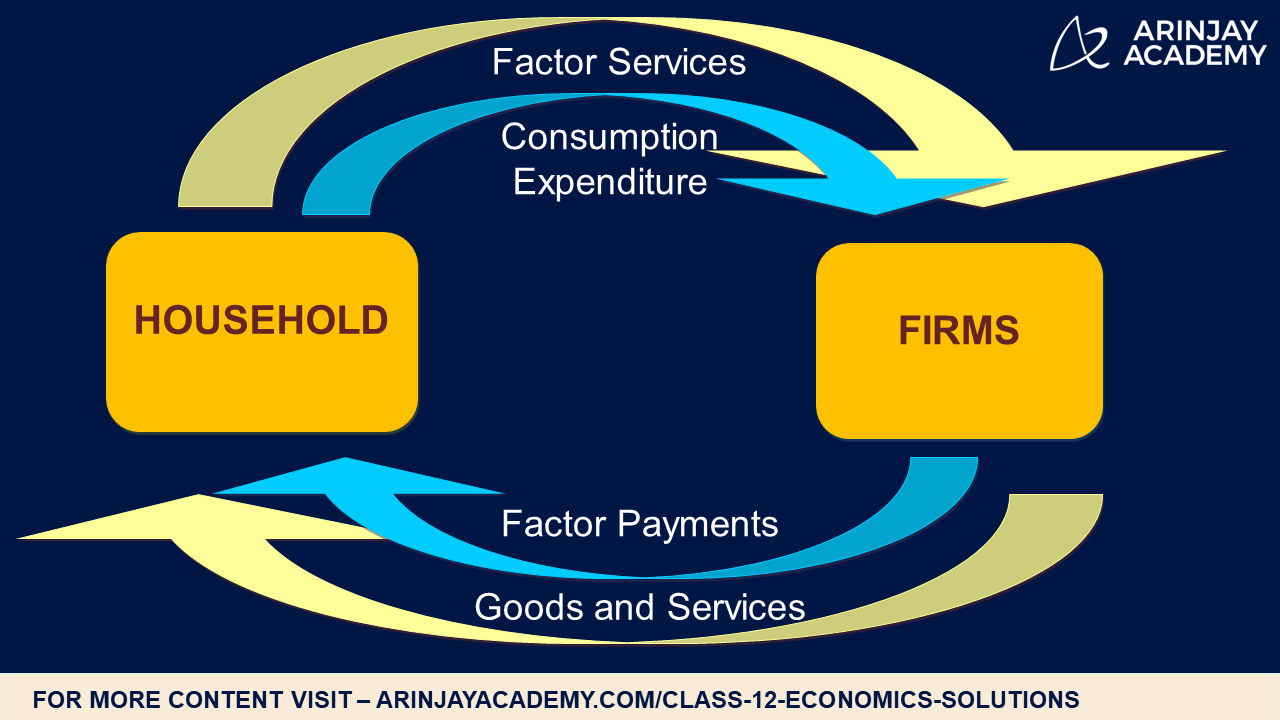
- The outer loop shows the real flow of income and the inner loop shows the money flow of income.
- So there is a circular and continuous flow of money income as the entire factor payment is received back with firms through consumption expenditure.
- This flow of income continues as production is continuous process due to never ending human wants. It makes the flow of income circular.
Sandeep Garg Macroeconomics Class 12 Solutions Circular flow of Income – Short Questions
Q.4 “Households and Firms depend on each other in the circular flow of income. Justify the statement in case of a two-sector model.
Sol. Households and firms are interdependent of each other for the economy to work well. In Circular Flow of income, both of them are the very important factors. It is their dependence that the economy is in a continuous process.
- Household sector provides factor services and makes consumption expenditure on goods and services.
- Firms produce goods and services and make factor payments to household sector.
- There are no savings in the economy which means all income is spent on consumption.
- The outer loop shows the real flow of income and the inner loop shows the money flow of income.
- So there is a circular and continuous flow of money income as the entire factor payment is received back with firms through consumption expenditure.
- This flow of income continues as production is continuous process due to never ending human wants. It makes the flow of income circular and proves that both the sectors are very important part of the model and interdependent on each other.
Sandeep Garg Macroeconomics Class 12 Solutions Circular flow of Income – Short Questions
Q.6. Discuss briefly, the circular flow of income in a two sector economy with the help of a suitable diagram.
TWO SECTORAL Economy or SIMPLE Economy assumes only two sectors: Household and Firms.
Some assumptions that are taken for the better understanding of this system are:-
- There are only two sectors in an economy i.e. households and firms.
- Household sector provides factor services (land, labor, capital, entrepreneur) to the firms and makes consumption expenditure on goods and services produced by the firms.
- Firms produce goods and services with the help of factor services and make factor payments (rent, wages, interest, profit) to household sector.
- There are no savings in the economy by the household sector which means all income is spent on consumption.
- The outer loop shows the real flow of income and the inner loop shows the money flow of income.
- So there is a circular and continuous flow of money income as the entire factor payment is received back with firms through consumption expenditure.
- This flow of income continues as production is continuous process due to never ending human wants. It makes the flow of income circular.
Sandeep Garg Macroeconomics Class 12 Solutions – Long Questions
Q.2 Describe the circular flow of income in a two-sector economy (without financial market).
Solution:-
Circular flow of income represents the flow of money among the different sectors of an economy.
Two Sectoral Economy or Simple Economy assumes only two sectors: Household and Firms.
- Households refer to the consumer sector in the economy which provides factors of production to firms and do consumption of goods and services.
- Firms refer to the production sector that produces the goods and services with the help of factors of production.
A closed economy consists of households, firms, government and financial sector and not the rest of the world.
An open economy consists of households, firms, government, financial sector and rest of the world.
Factors of production refer to those inputs which are required for the production of goods and services. For example: Land, Labor, Capital and Entrepreneur.
Factors payments or factor services refer to those outputs which the supplier of factors of production gets in return of their usage. For example: Rent, Wages, Interest and Profits.
Some assumptions are taken for better understanding of this system. These are:-
- There are only two sectors in an economy i.e. households and firms.
- Household sector provides factor services and makes consumption expenditure on goods and services.
- Firms produce goods and services and make factor payments to household sector.
- There are no savings in the economy which means all income is spent on consumption.
- The outer loop shows the real flow of income and the inner loop shows the money flow of income.
- So there is a circular and continuous flow of money income as the entire factor payment is received back with firms through consumption expenditure.
- This flow of income continues as production is continuous process due to never ending human wants. It makes the flow of income circular.