ASSESSMENT AND COLLECTION OF TAX OF NON-RESIDENT ENGAGED IN SHIPPING BUSINESS – SECTION 172 OF INCOME TAX ACT
SECTION 172 OF INCOME TAX ACT – APPLICABILITY
The provisions of Section 172, apply for the purpose of levy , and recovery of tax in case of shipping business of non-residents, provided the following conditions are satisfied: –
- Non-resident assessee should be engaged in shipping business.
- Ship should belong to the non-resident, or chartered by non-resident.
- Ship carries passengers, livestock, mail or goods shipped at Indian port. In case passengers, livestock, mail or goods are shipped at a port outside India, the provision of Section 172 shall not be applicable.
Once the aforesaid conditions are satisfied, the following provisions shall apply : –
- Taxable income of the non-resident shall be equal to 5% (i.e., presumptive income) of the amount paid or payable . The sum chargeable to tax under this section shall include amounts payable by way of demurrage charge or handling charge or any other amount of similar nature [Section 172(8)].
- Such amount may be paid or payable to the owner or charterer or to any person on his behalf,
- Such amount is paid or payable on account of carriage of passengers etc. shipped at any port in India.
- The amount may be paid or payable in India or outside India.
RETURN OF THE AMOUNT PAID TO THE NON-RESIDENT
In order to ensure collection of taxes on income of the NR, the master of the ship is under an obligation to furnish a return of the full amount which is taxable as above, since the last arrival of the ship thereat, and furnish such return to the AO.
NOTE :
While the return of income is, ordinarily required, to be furnished before the departure of the ship, from the port in India, of the ship, however, the master of the ship may authorise a person to file such return within 30 days of the departure of the ship from the port, if:
- the AO is satisfied that it is not possible for the master of the ship to furnish the return before ships departure ; and
- the master of the ship has made satisfactory arrangement for the filing of the return and payment of tax by any other person on this behalf.
SUMMARY ASSESSMENT – SECTION 172(4) OF INCOME TAX ACT
On receipt of return of income from Master of the ship or the authorised person, the Assessing Officer shall determine the tax payable on the taxable income.
EXAMPLE : –
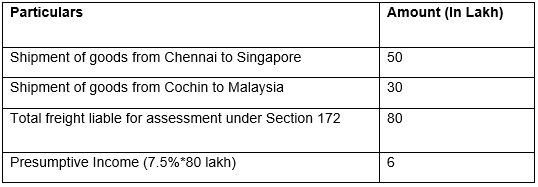
Mover Shipping Pte. Singapore is engaged in shipping business. It collects following freight on account of shipment of goods in India :
- A sum of Rs. 50 lakhs for shipment of goods from Chennai to Singapore (Freight collected in India)
- A sum of Rs. 30 lakhs for shipment of goods from Cochin to Malaysia (freight collected in Malaysia)
On basis of above, answer following questions :
- Whether non-resident is liable to file return under Section 172 before departure of ship?
- Compute the presumptive income of non-resident under Section 172 ?
SOLUTION : –
a) Provisions for recovery and collection of tax under Section 172 are applicable to non-resident only when ship carrying passengers, livestock, etc. shipped at Indian port whether freight is paid or payable in India or outside India.
Thus, master of the ship is liable to file return under Section 172 before departure of ship and pay tax on presumptive income.
A. Computation of presumptive income under Section 172 of Income Tax Act is as under: –
EXAMPLE : –
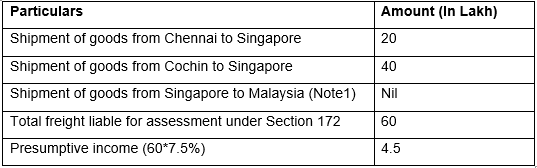
Sirine LLC is a company incorporated in UAE and is engaged in shipping business. It collects following freight on account of various shipments :
- A sum of Rs 20 lakh for shipment of goods from Chennai to Singapore (Freight collected in Singapore)
- A sum of Rs 40 lakh for shipment of goods from Cochin to Singapore (Freight collected in India)
- A sum of Rs 30 lakhs for shipment of goods from Singapore to Malaysia (freight collected in Malaysia)
On basis of above, answer following questions:
- Compute the presumptive income of Non-resident, under Section 172 ?
- Whether non-resident is liable to file return under Section 172 for all freight collected before departure of ship?
SOLUTION : –
Presumptive income under Section 172 is as under:
NOTE :
1. Provisions of for levy and recovery of tax shall not apply when ship carrying passengers, livestock, etc are shipped at port outside India whether freight is paid or payable in India or outside India.
a) Sirine LLC is liable to file return before departure of ship only for freight of Rs 60 lakh and master of ship would be liable to pay tax on presumptive income of Rs 4.5 lakh.
Tax on presumptive taxable income, is calculated at tax rates applicable to a foreign company (40% , excluding SC + Cess, as applicable). The master of the ship is liable for payment of such tax.
EXAMPLE : –
Based on facts of preceding example and assuming the assessee is a non-resident, compute the tax liability which is to be paid before departure of ship ?
SOLUTION : –
The Tax payable on presumptive income would be 40% (excluding SC + Cess), i.e 40% of Rs. 4.5 lakh or Rs 1.80 lakh (Rs 4.5 lakh *40%)
Supreme Court, in A.S. Glittre v CIT (1997) 225 ITR 739 (SC) – Assessment made under section 172(4) shall be an ‘adhoc’ assessment and will be superceded, if a regular assessment is opted as per the provisions of the Act.
TIME LIMIT FOR PASSING THE ASSESSMENT ORDER – SECTION 172(4A) OF INCOME TAX ACT
AO shall pass the assessment order within a period of 9 months, from the end of the financial year in which the return of income under section 172(3) is filed. For determining the tax payable, Assessing Officer may call for such accounts and documents, as he may consider necessary [section 172(5)].
GRANT OF PORT OF CLEARANCE TO THE SHIP
Before granting any port clearance to the ship, the Collector of customs or other authorized officer, should be satisfied that : –
- Tax assessable under section 172 has been duly paid ; or
- Satisfactory arrangements have been made by the non-resident/master of the ship, for the payment of Tax assessable under section 172 [Section 172(6)].
OPTION TO PAY TAX AS PER NORMAL PROVISIONS OF THE IT ACT ON SHIPPING INCOME
The owner or charterer , instead of opting for provision of Section 172 as final assessment, has an option to claim that an assessment in respect of his total income for the previous year and the tax payable on the basis thereof be determined in accordance with the other provisions of the IT Act.
However, such option should be exercised before the expiry of the assessment year relevant to the previous year in which the date of departure of the ship from the Indian port falls.
NOTES : –
If a non-resident does not opt to be governed by provision of Section 172 , any tax payment section 172 is treated as an advance tax. If the tax due on assessment is higher than such advance tax, the difference between the sum so paid and the amount of tax found payable on such assessment is to be paid by him (i.e., when tax payable > Advance tax under Section 172). However, if the tax due on assessment is lower than such advance tax, the difference is to be refunded to him (i.e., when advance tax under Section 172 > Tax payable) .
EXAMPLE : –
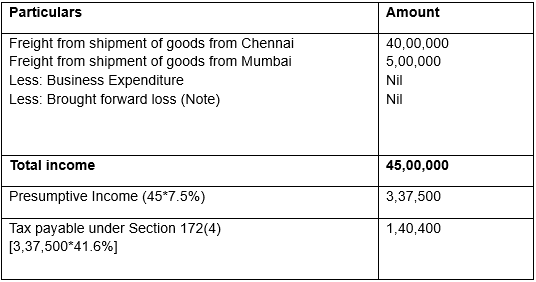
Paul Inc., a non-resident, was engaged in shipping business. it collected the following freight during FY 2019-20 : –
- On July 1, 2019, a sum of Rs. 40 lakhs for shipment of goods from Chennai.
- On August 7, 2019, a sum of Rs. 5 lakh for shipment of goods from Mumbai.
It incurred expenses of Rs.43 lakh for his shipping business during FY 2019-20.
It also has brought forward business loss of Rs. 20,000.
Compute tax liability of Paul Inc. for FY 2019-20 ?
SOLUTION : –
Ad-hoc assessment under Section 172(4)
NOTE :
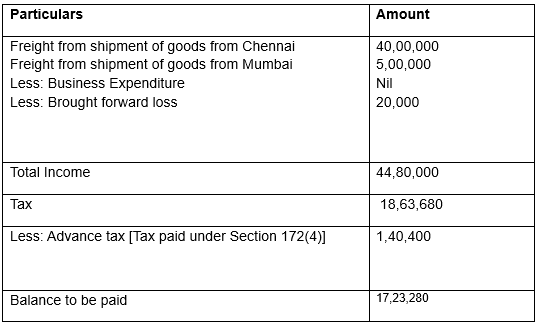
Assuming the Master of ship had filed return before the departure of the ship, and paid tax of Rs 1,40,400 during FY 2019-20, such tax would be treated as advance tax if assessee opts for normal assessment under Section 172(7).
If Paul Inc. opts for normal assessment under Section 172(7) then tax will be computed as under : –
POINTS TO CONSIDER :-
- Provisions of set-off and carry forward are not applicable while computing tax liability under provisions of Section 172(4)
- Deductions under Chapter VI-A would not be allowed while computing tax liability under provisions of Section 172(4)
Comparison between provisions of Section 44B and Section 172
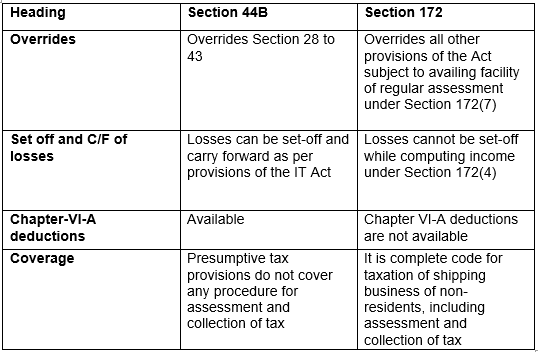
The Karnataka High Court in the case of V. M. Salgaocer & Bros Ltd. v. Deputy Controller (1991)187 ITR 381 has held that regular shipping business are covered by section 44B and they will be assessed in accordance with the provision of the Act at the rates specified in section 44B, while causal visit to Indian ports is covered by section 172.