CA Final International Taxation MCQs – Non Resident Taxation answers with detailed explanations are given at the end of questions. The pattern of CA Final International Taxation question paper is 30% objective and 70% descriptive under the Old and New Schemes.
1. Which of the following is the basis of taxing Cross – Border transactions: –
a. Residence of the taxpayer
b. Where is the Source of income
c. Both A and B
d. Neither A nor B
2. Under Residence based taxation, taxation of an individual is based on : –
a. Country of their residence
b. Whether the source of income is in or outside the country of residence
c. Both A and B
d. Neither A nor B
3. Under Residence based taxation, taxation of an companies is based on : –
Place where they are incorporated or
Place of Effective Management
a. Both A and B
b. Neither A nor B
4. POEM stand for
a. Place of Effective Management
b. Place of residence of Effective Manager
c. Place of Employee Matters
d. Place of Employee Management
5. Assessee includes : –
a. Individual, HUF, Firm, Company, AOP/BOI, etc.;
b. Any person by whom any Tax is payable under the Income Tax Act
c. Any person by whom penalty or interest is payable under the Income Tax Act
d. All of the above
6. Assessee includes person in respect of whom any proceedings have been undertaken for : –
a) Assessment of his income or loss incurred by him ;
b) Assessment of income or loss incurred by any other person, for whom he is assessable
c) Assessment of refund due to him or any other person
d) All of the above
7. A, is a non-resident Indian who moved out of India in 2013-14. He did not file his return since he moved out of India . The tax Department issued a notice to A to file return of income under the belief that he had taxable income based on information available with them from third party assessment. Whether, A is an assesse within the meaning of Income Tax Act, 1961 ?
a. Yes
b. No
8. Alco Inc. is a foreign company which derived certain royalty income/ taxable business income during 2016-17. It did not file its tax return for the said year, even though the due date of filing return expired. The tax Department issued a notice to Alco Inc. to file return of income. Whether, Alco Inc. is an assesse within the meaning of Income Tax Act, 1961 ?
a. Yes
b. No
9. Assessee includes : –
a. Persons Deemed to be an assessee (e.g. representative assesses u/s 160 for non-resident)
b. Persons Deemed to be an Assessee in default [ under section 201(1) for non-deduction/ non deposit of tax, under Section 218 for non-deposit of advance tax ]
c. Both A and B
d. Neither A nor B
10. Which of the following is included within the definition of Person: –
a) Individual;
b) Hindu Undivided Family
c) Company;
d) All of the above
CA Final International Taxation MCQs – Non Resident Taxation
11. Which of the following is included within the definition of Person: –
a) Firm;
b) An Association of Persons or Body of individuals ;
c) A Local Authority ;
d) All of the above
12. What would be the “Assessment year” if income is received on September 30, 2017 : –
a. 2016-17
b. 2017-18
c. 2018-19
d. Neither of the above
13. What would be the “Assessment year” if income is received on March 30, 2017 : –
a. 2016-17
b. 2017-18
c. Neither of the above
14. What would be the “Assessment year” if income is received on September 30, 2016 : –
a. 2016-17
b. 2017-18
c. Neither of the above
15. What would be the “Previous year” if income is received on September 30, 2017 : –
a. 2016-17
b. 2017-18
c. Neither of the above
16. What would be the “ Previous year” if income is received on October 30, 2016 : –
a. 2016-17
b. 2017-18
c. Neither of the above
17. Assessment Year —— Previous year : –
a. Precedes
b. Succeeds
c. Is simultaneous with
18. What would be the Assessment Year for Previous year 2016-17 : –
a. 2016-17
b. 2017-18
c. 2018-19
19. What would be the Assessment Year for Previous year 2017-18 : –
a. 2016-17
b. 2017-18
c. 2018-19
20. What would be the Assessment Year for Previous year 2015-16 : –
a. 2016-17
b. 2017-18
c. 2018-19
CA Final International Taxation MCQs – Non Resident Taxation
21. What would be the Previous year for Assessment Year 2016-17 : –
a. 2016-17
b. 2017-18
c. 2015-16
22. What would be the Previous year for Assessment Year 2017-18 : –
a. 2016-17
b. 2017-18
c. 2018-19
23. What would be the Previous year for Assessment Year 2015-16 : –
a. 2016-17
b. 2014-15
c. 2018-19
24. Domestic company means a company which is : –
a) An Indian company; or
b) Company which has made prescribed arrangements for the declaration and payment of dividends (including dividend on preference shares) within India, out of its income taxable in India.
c) Both A and B
d) None of the above
25. Alpha Inc, a company incorporated in USA , has made prescribed arrangement for the declaration and payment of dividends within India . Alpha Inc would be a
a. Foreign company for Indian Income Tax Act purpose
b. Domestic company for Indian Income Tax Act purpose
26. XYZ India Private Limited, is a company incorporated in India , but its place of effective management is in UAE. XYZ India would be a
a. Foreign company for Indian Income Tax Act purpose
b. Domestic company for Indian Income Tax Act purpose
27. A person who is a Resident in India , should be so covered with the provision of
a. Section 6
b. Section 9
c. Section 90
28. “Non-resident’’ means
a. a person who is not a “resident”;
b. a person who is a “resident”,
c. For the purposes of Section 92, Section 93 and Section 168 includes a person who is not ordinarily resident within the meaning of clause (6) of section 6.
d. Both A and C
29. A, is a NRI, who is resident but not ordinarily resident within the meaning of Section 6(6). He received dividend from an Indian company where he owns 51%. For the purpose of Transfer Pricing provisions, he would be considered a : –
a. Non resident
b. Resident
30. Alpha Inc., a company incorporated in USA , has an Indian subsidiary, Beta India Private Limited. Alpha Inc. sold the shares of Beta India to Gama Singapore. Such a sale: –
a. Would constitute a transfer and liable to Capital gains tax in India;
b. Would constitute a transfer and liable to Capital gains tax in India, subject to any Treaty benefits
c. Would not constitute a transfer and would not be liable to Capital gains tax in India
CA Final International Taxation MCQs – Non Resident Taxation
31. Alpha Inc., a company incorporated in USA , has an Indian subsidiary, Beta India Private Limited. Alpha Inc. exchanged the shares of Beta India with shares of Gama Singapore. Such a transaction : –
a. Would constitute a transfer and liable to Capital gains tax in India;
b. Would constitute a transfer and liable to Capital gains tax in India, subject to any Treaty benefits
c. Would not constitute a transfer and would not be liable to Capital gains tax in India
32. Alpha Inc., a company incorporated in USA , has an Indian subsidiary, Beta India Private Limited. Beta India did a capital reduction of its shares whereby it reduced the face value from Rs. 10 to Rs. 5 and paid Alpha Inc. Such a transaction : –
a) Would constitute a transfer and liable to Capital gains tax in India;
b) Would constitute a transfer and liable to Capital gains tax in India, subject to any Treaty benefits
c) Would not constitute a transfer and would not be liable to Capital gains tax in India
33. Alpha Inc., a company incorporated in USA , had an office in India which constituted its PE. In order to construct a Railway track, the Government acquired the building where the office was situated and paid Alpha Inc., Rs. 10 crores. Such a transaction : –
a. Would constitute a transfer and liable to Capital gains tax in India;
b. Would constitute a transfer and liable to Capital gains tax in India, subject to any Treaty benefits
c. Would not constitute a transfer and would not be liable to Capital gains tax in India
34. Alpha Inc., a company incorporated in USA was engaged in manufacturing and selling software. It has an Indian subsidiary, Beta India Private Limited. Alpha Inc., changed its business to a dealer in shares and converted shares of Beta India , which was a capital asset into stock in trade. Such a transaction : –
a) Would constitute a transfer and liable to Capital gains tax in India;
b) Would constitute a transfer and liable to Capital gains tax in India, subject to any Treaty benefits
c) Would not constitute a transfer and would not be liable to Capital gains tax in India
35. Income tax is chargeable on income earned during the previous year. Which of the following can be exceptions to this Rule : –
a. Section 172,
b. Section 174
c. Section 174A,
d. Section 175
e. All of the above
36. Income-tax in respect of income chargeable to tax under section 4(1) of the IT Act, is payable by way of : –
a) Tax deducted at source
b) Advance Tax
c) Self Assessment Tax
d) All of the above
37. The rates of tax payable by Foreign companies as per Income Tax Act, 1961 is : –
a. 40%.
b. 30%.
c. 25%
38. The rates of surcharge payable by a Foreign company as per Income Tax Act, 1961 is : –
a. Surcharge @ 2% of such income-tax, where the total income exceeds Rs. 1 crore but does not exceed Rs. 10 crores.
b. 5% of such income tax where total income exceeds Rs. 10 crores.
c. Both of the above
d. None of the above
39. The rates of cess tax payable by foreign companies as per Income Tax Act, 1961 is : –
a. Education Cess of 2%
b. Secondary and Higher Education Cess (SHEC) of 1%,
c. Both of the above
d. None of the above
40. Resident taxpayers are liable to pay tax on their : –
a. Global income
b. Only India sourced income
c. Only Foreign income.
CA Final International Taxation MCQs – Non Resident Taxation
41. Non – Resident taxpayers are liable to pay tax on their : –
a. Global income
b. Only India sourced income
c. Only Foreign income.
42. On the basis of their Residential Status, taxpayers are classified into : –
a. Resident and not ordinarily resident
b. Non Resident
c. Resident and ordinarily resident
d. Either of the above
43. An individual is said to be resident in India in any previous year, if he satisfies any — of the basic conditions : –
a. One
b. Both
c. Both the Basic conditions and atleast one additional condition
44. Which one of the following is not a basic condition to determine residential status of an individual : –
a) He has been in India during the previous year for a total period of 182 days or more ;
b) He has been in India during the previous year for a total period of 182 days or less ;
c) He has been in India during the 4 years immediately preceding the previous year for total period of 365 days or more and has been in India for at least 60 days in the previous year .
d) Both A and C
45. An individual is said to be non resident in India in any previous year, if he satisfies any — of the basic conditions : –
a. One
b. Both
c. None
46. Abraham, an Indian citizen, left India during previous year 2016-17, for the purpose of employment outside India on August 31, 2016. He was in India during the 4 years immediately preceding the previous year for total period of more than 365 days . He would be a : –
a. Resident in India
b. Non Resident in India
47. Relan, an Indian citizen, left India during previous year 2016-17, as a member of the crew of an Indian ship for the purposes of employment outside India, on September 15, 2016. He was in India during the 4 years immediately preceding the previous year for total period of more than 365 days . He would be a : –
a. Resident in India
b. Non Resident in India
48. Samir , an Indian citizen was living outside India since 2012 and comes on a visit to India in previous year 2016-17 for 180 days. In such a case, he would be : –
a. Resident in India
b. Non Resident in India
49. A PERSON IS SAID TO BE OF INDIAN ORIGIN if : –
a. He was born in undivided India or
b. Either of his parents were born in undivided India
c. Either of his grandparents were born in undivided India.
d. All of the above
50. A person , who is a resident, is said to be RESIDENT AND ORDINARILY RESIDENT if he satisfies —- of the additional conditions specified under section 6(6) : –
a. One
b. Both
c. None
CA Final International Taxation MCQs – Non Resident Taxation
51. Which one of the following is the additional conditions specified under section 6(6) for a resident to be resident and ordinarily resident : –
a) Individual has been resident in India in 2 out of 10 previous years immediately preceding the relevant previous year.
b) Individual has been resident in India in 3 out of 10 previous years immediately preceding the relevant previous year.
c) Individual has been resident in India in 4 out of 10 previous years immediately preceding the relevant previous year.
52. Which one of the following is the additional conditions specified under Section 6(6) for a resident to be resident and ordinarily resident : –
a) Individual has during the 7 previous years preceding the relevant previous year been in India for a period of 730 days or more.
b) Individual has during the 7 previous years preceding the relevant previous year been in India for a period of 830 days or more.
c) Individual has during the 8 previous years preceding the relevant previous year been in India for a period of 730 days or more.
53. An individual is said to be a resident but not ordinarily resident (RNOR) if he —– any of the additional conditions
a. Fails to satisfy
b. Satisfies
54. Which of the following can be RNOR/ROR : –
a) Individuals and
b) HUFs
c) Company
d) Both A and B
55. Residential status is to be determined on : –
a) Every five years
b) Year to Year basis
c) Initial Year of incorporation
d) Both A and B
56. “Stay in India” to determine residential status includes : –
a. Stay in the territorial waters of India
b. Stay in a ship or boat moored in the territorial waters of India
c. Date of departure as well as the date of arrival in India
d. All of the above
57. Which of the following are not relevant in determining the residence of an individual for income-tax purpose : –
a. Citizenship, place of birth or domicile.
b. Whether period of stay is continuous
c. Whether stay is at the usual place of residence, business or employment of the individual.
d. All of the above
58. Rahul is a Indian citizen working at a MNC in Mumbai. He was given an opportunity to work on an assignment in UK for such MNC. He had never visited any foreign country earlier and left India on June 30, 2016. His residential Status for Fy 2016-17 would be ?
a) Resident
b) Non Resident
c) Resident but not ordinarily resident
59. Jerry is a foreign citizen outside India, who is a person of Indian origin. He comes on visit to India on January 1, 2017. He left India on April 1, 2017. His residential Status for FY 2016-17 would be ?
a) Resident
b) Non Resident
c) Resident but not ordinarily resident
60. Ramesh is working in MNC located at Gurgaon. He had taken foreign visit on various occasion due to company’s work. However, he had not taken any foreign visit during he previous year 2017-18. His stay in India during the last 7 years is given as under :-
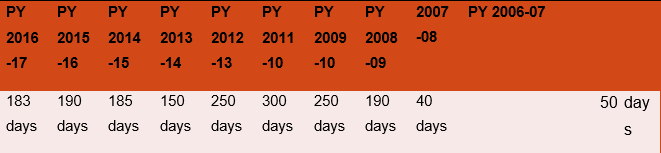
His residential Status for FY 2016-17 would be ?
a) Resident
b) Non Resident
c) Resident but not ordinarily resident
d) Resident and Ordinarily resident
CA Final International Taxation MCQs – Non Resident Taxation
61. The basis of determining the period of stay in India for an Indian citizen, being a crew member is governed by CBDT has vide, Notification No. 70/2015 dated 17.8.2015, inserted Rule 126 in the Income-tax Rules, 1962. Which of the following is true for excluding period of stay in India : –
a) Exclusion Period commences from – Date entered into Continuous Discharge Certificate, in respect of joining the ship by the said individual
b) Exclusion Period ends on Date entered into the Continuous Discharge Certificate ,in respect of signing off by that individual from the ship
c) Both the above
d) None of the above
62. Out of the following persons, who would be resident in India if the control and management of their affairs is situated wholly or partly in India : –
a. HUF,
b. FIRM,
c. AOP/BOI,
d. LOCAL AUTHORITIES AND ARTIFICIAL JURIDICAL PERSONS
e. All of the above
63. Out of the following persons, who would be a non resident in India if the control and management of their affairs is situated wholly outside India : –
a. HUF,
b. FIRM,
c. AOP/BOI,
d. LOCAL AUTHORITIES AND ARTIFICIAL JURIDICAL PERSONS
e. All of the above
64. Control and Management of HUF is with : –
a. Its Karta
b. Owner
c. Any member of the family
d. None of the above.
65. Control and Management of Firm/AOP is with its : –
a. Partners/Members.
b. Lender
c. Any member of the partners family
d. None of the above.
66. An HUF, which is resident in India, can be : –
a. Resident and Ordinarily Resident
b. Resident and not Ordinarily Resident
c. Non Resident
d. All of the above
67. Whether an HUF, is a Resident and Ordinarily Resident in India, would be dependent upon : –
a. whether the Karta of Resident HUF satisfies the additional conditions applicable to Individuals ;
b. Residential status of the HUF
c. Both the above
d. None of the above
68. Inder, a non resident, is a Karta of Resident HUF. The HUF would be : –
a. Resident and Ordinarily Resident
b. Resident and not Ordinarily Resident
c. Non Resident
69. Maninder, a resident and ordinarily resident, is a Karta of Resident HUF. The HUF would be : –
a. Resident and Ordinarily Resident
b. Resident and not Ordinarily Resident
c. Non Resident
70. Suvinder, is a Karta of Resident HUF. 1. He was a resident of India in 3 previous years out of 10 previous years immediately preceding relevant previous year and stayed in India during last 5 previous year immediately preceding relevant previous year for 740 days . The HUF would be : –
a. Resident and Ordinarily Resident
b. Resident and not Ordinarily Resident
c. Non Resident
CA Final International Taxation MCQs – Non Resident Taxation
71. Firms, Association of persons, Local Authorities and other artificial juridical persons can be : –
a. Resident and Ordinarily Resident
b. Resident and not Ordinarily Resident
c. Non Resident
d. Resident
e. Both c and d
72. The head office of XYZ, HUF was situated in UK. What would be the residential status of HUF for PY 2017-18 when affairs of HUF are managed from UK ?
a. Resident and Ordinarily Resident
b. Resident and not Ordinarily Resident
c. Non Resident
d. Resident
73. The head office of XYZ, HUF was situated in UK. What would be the residential status of HUF for PY 2017-18 when affairs of HUF are managed from partly from India ?
a. Resident and Ordinarily Resident
b. Resident and not Ordinarily Resident
c. Non Resident
d. Resident
74. If the Karta is a resident of India, determine its residential Status if the Karta of HUF is present in India for more than 730 days during the preceding 7 years and is also resident in India in 8 years out of preceding 10 years ?
a. Resident and Ordinarily Resident
b. Resident and not Ordinarily Resident
c. Non Resident
d. Resident
75. The importance of residential status of a company is that : –
a. For Resident companies, global income is taxable ;
b. For Non Resident companies, India sourced income is taxable
c. Both A and B
d. Neither A nor B
76. Until ASSESSMENT YEAR 2016-17 , a company is said to be resident in India in any previous year, if it is
a. an Indian Company ; or
b. During that year, the control and management of its affairs is situated wholly in India.
c. Place of Effective Management (‘POEM’), in that year, is in India.
d. Both A and B
77. From ASSESSMENT YEAR 2017-18 , a company is said to be resident in India in any previous year, if it is
a. An Indian company;
b. During that year, the control and management of its affairs is situated wholly in India.
c. Place of Effective Management (‘POEM’), in that year, is in India.
d. Both A and C
78. “Place of effective management” means a place where key management, and commercial decisions
a. that are necessary for the conduct of the business of an entity as a whole are in appearance made.
b. that are necessary for the conduct of the business of an entity as a whole are in substance made.
c. that are necessary for the financing of business of an entity as a whole are in appearance made.
d. that are necessary for the conduct of the general operations of an entity as a whole are in substance made.
79. POEM, is an —- test to determine, whether a company incorporated in a foreign jurisdiction, is a tax resident of another country.
a. Internationally acceptable
b. India based
c. Both A and B
d. Neither A nor B
80. Most of the Indian tax treaties recognize the POEM concept as a —- to determine residence of a company, for avoidance of double taxation : –
a. Basic rule
b. Tie-breaker rule
c. General rule
d. None of the above
CA Final International Taxation MCQs – Non Resident Taxation
81. Tie-breaker rule , in the context of Treaty , is applied where : –
a. A person could be a Resident of both the Treaty partner countries
b. A person is liable to pay tax in both the Treaty partner countries
c. Where income may be taxable under two or more Article
d. None of the above
82. To ascertain POEM applicability, the companies are classified into : –
a) Companies engaged in “Active Business Outside India”,
b) Companies engaged in “Active Business in India”,
c) Companies not engaged in “Active Business Outside India”.
d) Both A and C
83. POEM of companies engaged in “Active Business Outside India” (ABOI) shall be presumed to be outside India if : –
a. Majority of the Board meeting are held outside India;
b. Majority of the Board meeting are held in India;
c. All the Board meeting are held outside India;
d. Both A and C
84. In case of Alpha Inc. majority of the Board meeting are held in USA. However, the Board of the company was a paper Board and all the decision were taken by Beta India private Limited , the Holding company of Alpha Inc. The POEM of Alpha Inc. in such a case would be : –
a. In India;
b. In USA, since the majority of Board meeting are held in USA;
c. Both India and USA
d. Neither A nor B
85. In case of Alpha Inc. majority of the Board meeting are held in USA. However, the Board of the company was a paper Board and all the decision were taken by AGMG, India, a professional firm that managed the business of Alpha Inc. The POEM of Alpha Inc. in such a case would be : –
a) In India;
b) In USA, since the majority of Board meeting are held in USA;
c) Both India and USA
d) Neither A nor B
86. FCO satisfies the test of Active Business Outside India. During the year 5 meetings of its Board of Directors were held of which 2 were held in India and 3 outside India.However, Board of Directors are not exercising powers of management and such powers are being exercised by ‘Indian holding Company’ (IHC) . The POEM of FCO would be : –
a. In India;
b. Outside India
c. Both India and Outside India
d. Neither A nor B
87. Hardbank Japan is wholly owned subsidiary of ICO. Parent company (i.e., ICO) laid down principles of supply chain functions. Such principles are laid down for the entire group of companies. Board of Directors of Hardbank follows such principle of supply chain functions. Board of Directors of Hardbank are —- their powers of management?
a. Not exercising
b. Exercising
88. Which of the following global policy of the entire group (not being specific to any entity or group of entities), laid down by parent entity, if followed by the Board of Directors , shall not result in the Board of Directors not exercising their powers of management, for the purpose of ascertaining Place of Management of a company : –
a. Pay roll functions,
b. Accounting,
c. Human resource (HR) functions,
d. All of the above
89. Which of the following global policy of the entire group (not being specific to any entity or group of entities), laid down by parent entity, if followed by the Board of Directors, shall not result in the Board of Directors not exercising their powers of management, for the purpose of ascertaining Place of Management of a company : –
a) IT infrastructure and network platforms,
b) Supply chain functions,
c) Routine banking operational procedures,
d) All of the above
90. For companies not engaged in “Active Business Outside India”, the determination of POEM would involve which of the following :-
a) Identifying the person(s) who actually make the key management and commercial decisions for the conduct of the company as a whole.
b) Determine the place where these decisions are, in fact, being made.
c) Both A and B
d) Neither A nor B
CA Final International Taxation MCQs – Non Resident Taxation
91. POEM of Foreign Company would be outside India where : –
a. Key management decisions are taken outside India.
b. Key commercial decisions are taken outside India.
c. Key management and commercial decisions are taken outside India.
d. Key management and commercial decisions are taken in India.
92. In determining POEM, which of the following is more important : –
a. Place where management/commercial decisions are taken
b. Place where management/commercial decisions are implemented.
c. Place where Directors reside
d. None of the above
93. A company shall be said to be engaged in ‘Active Business Outside India’ if it satisfies which of the the following conditions:
a) Its passive income is 50% (or less) of its total income;
b) less than 50% of its total asset are situated in India;
c) Both A and B
d) Neither A nor B
94. A company shall be said to be engaged in ‘Active Business Outside India’ if it satisfies which of the the following conditions:
a. less than 50% of total number of employees are situated in India or are resident in India;
b. the payroll expenses incurred on such employees is less than 50% of its total payroll expenditure.
c. Both A and B
d. Neither A nor B
95. For the purpose of determining Active Business Outside India, the average of the data of which of the following years would be considered : –
a. the previous year and two years prior to that
b. the previous year
c. Last two years
d. None of the above
96. In case the company has been in existence for less than two years, for the purpose of determining Active Business Outside India, the data of which of the following years would be considered
a. Data of period of existence of the company;
b. Last 6 months, if the company exists for more than 6 months;
c. Last 12 months , if the company exists for more than 12 months
d. None of the above
97. For the purpose of determining Active Business Outside India , where the accounting year for tax purposes, in accordance with laws of country of incorporation of the company, is different from the previous year, then, data of the accounting year of the Foreign Company that — shall be considered : –
a. ends during the relevant previous year and two accounting years preceding previous year
b. ends during the relevant previous year and last accounting year preceding previous year
c. Both A and B
d. Neither A nor B
98. FCO is located in Mauritius. Its accounting year for tax purposes is 1 July – 30 June of every year. Which year’s data should be used in order to apply ‘Active Business Outside India’ test for FY 2016-17?
a. 2015-16 – July 1, 2015 to June 30, 2016,
b. 2014-15 – July 1, 2014 to June 30, 2015 and
c. 2013-14 – July 1, 2013 to June 30, 2014.
d. All of the above
99. Passive income of a company shall be aggregate of : – (EG)
a. Income from the transactions where both the purchase and sale of goods is from/ to its Associated Enterprises.
b. Income from the transactions where purchase is from Associated Enterprise but sale is not to an Associated Enterprise;
c. Income from the transactions where purchase is not from Associated Enterprise but sale is to an Associated Enterprise;
d. All of the above
100. Passive income of a company shall be include : –
a. Income by way of royalty ;
b. Income by way of dividend ;
c. Income by way of capital gains ;
d. All of the above
CA Final International Taxation MCQs – Non Resident Taxation
101. Passive income of a company shall exclude : –
a. All Interest income
b. Interest income of banking companies
c. Interest income of public financial institutions
d. Both B and C
102. Passive income of a company shall include : –
a. Rental income.
b. All Interest income
c. Both A and B
d. Neither A nor B
103. To constitute , Passive income : –
a. It should be between two Associated Enterprises;
b. It need not be between two AE’s
c. Involvement of AE is not necessary
d. Both B and C
104. Income for the purpose of CFC, is to be : –
a. Computed for tax purpose in accordance with the laws of the country of incorporation.
b. Taken as per the books of account, where the laws of the country of incorporation do not require separate computation for tax purposes.
c. Both A and B
d. Neither A nor B
105. In case of company, incorporated in USA, passive income will be computed as per the taxation laws of —-
a. USA
b. India
c. IFRS
d. None of the above
106. To compute number of employees for cfc purpose,
a. The average of the number of employees as at the beginning and at the end of the Year are taken
b. The average number of employees as at the beginning of the Year are taken
c. The average number of employees as at the end of the Year are taken
d. The average number of employees for the last two years are taken
107. The term Payroll , for the purpose of ascertaining determining Active Business Outside India POEM includes –
a) Cost of salaries,
b) Wages and Bonus
c) Other employee compensation like related pension and social costs borne by the employer
d) All of the above
108. The passive income is — % of the total income of the company
a. 30
b. 40
c. 60
d. 100
109. Company A is —– engaged in active business outside India, as it satisifies the : –
a. The passive income test
b. The asset test
c. The employees test
d. All of the above
110. The location where a company’s Board regularly meets and makes decisions may be the company’s POEM, provided that the Board –
a. Retains authority to govern the company
b. Exercises authority to govern the company
c. Makes the key management and commercial decisions necessary for the conduct of the company’s business as a whole;
d. All of the above.
CA Final International Taxation MCQs – Non Resident Taxation
111. In order to determine the POEM of a company, mere formal holding of Board Meetings at a place would by itself —- conclusive :-
a. Be
b. Not be
c. May be
d. Cant say
112. The Directors of a company meet at Netherlands but the key decisions are taken in Delhi. The POEM of the company would be at
a. Delhi
b. Netherlands
c. Both A and B
d. Neither A nor B
113. The company’s POEM will ordinarily be the place where its senior managers or the other person who make those decisions reside if : –
a. Board has de facto delegated the authority to make the key management and commercial decisions to the senior management
b. Board routinely ratifies the decisions that have been made by senior management
c. Both A and B
d. Neither A nor B
114. Ralmart Inc. (‘USA’) held Board meeting at its office in India. Board of Directors of Ralmart Inc. makes all key management and commercial decisions at USA. The POEM of RalMart Inc would be in : –
a. USA
b. India
c. Cant say
d. Both A and B
115. “Senior Management” , to ascertain POEM of a foreign company , means the person or persons who are : –
a. generally responsible for developing and formulating key strategies and policies
b. ensuring or overseeing the execution and implementation of key strategies and policies
c. Both A and B
d. Neither A nor B
116. “Senior Management” , to ascertain POEM of a foreign company may include : –
a) Managing Director or Chief Executive Officer;
b) Financial Director or Chief Financial Officer;
c) Chief Operating Officer; and
d) All of the above
117. If a company’s Board has delegated some of its authority to Executive Committee consisting of senior management., the place which should be considered to be the company’s POEM would be : –
a. Location where the members of the executive committee are based
b. Location where that committee develops and formulates the key strategies and policies
c. Both A and B
d. Neither A nor B
118. If the Board has delegated ______________ authority to Senior Management, the company POEM would be the place where Senior Management makes commercial decisions : –
a. de jure (by means of a formal resolution or Shareholder Agreement)
b. de facto (based upon the actual conduct of the Board and the executive committee).
c. Either A or B
d. Neither A nor B
119. For purpose of POEM, “Head Office” of a company would be –
a. Place where the majority of its employees work or where its Board typically meets.
b. Place where the company’s senior management and their direct support staff are located ; or
c. Place where senior manageme are primarily located, if they are located at more than one location
d. Both B and C
120. If the company’s senior management and their support staff are decentralized then the company’s head office would be the location where these senior managers –
a. are primarily or predominantly based; or
b. normally return to following travel to other locations; or
c. meet when formulating or deciding key strategies and policies for the company as a whole.
d. All of the above
CA Final International Taxation MCQs – Non Resident Taxation
121. If the members of the senior management participate in various meetings via telephone or video conferencing the head office for ascertaining POEM would normally be the location, where : –
a. Majority of management is situated
b. Highest level of management and their direct support staff are located.
c. Largest office where maximum staff works
d. None of the above.
122. In situations where the senior management is so decentralised that it is not possible to determine the company’s head office with a reasonable degree of certainty, the location of a company’s head office : –
a. Would not be relevant in determining that company’s place of effective management.
b. Would still be most relevant in determining that company’s place of effective management.
c. Cant say
d. Neither of A and B
123. If the key decisions of the Board are in substance being made through use of Modern Technology, then, which one of the following is True : –
a. Physical location of Board Meeting may not be relevant;
b. Place where the Directors or majority of them usually reside may also be a relevant factor.
c. Place where the persons taking the decisions or majority of them usually reside may also be a relevant factor.
d. All of the above
124. In case of circular resolution, which of the following factors should be considered to determine POEM : –
a) The frequency with which circular resolution is used,
b) Location of proposer of decision
c) The type of decisions made through circular resolution
d) Both A and C
125. If the decisions are made by shareholder on matters reserved for shareholder decision under the company laws, such decision would ….. relevant for determination of a company’s POEM.
a. Be
b. Not be
c. May be
126. Matters reserved for shareholder decision under the company laws, which are irrelevant for determination of POEM may include –
a) Sale of all or substantially all of the company’s assets,
b) The dissolution, liquidation or deregistration of the company,
c) The modification of the rights attaching to various classes of shares or the issue of a new class of shares etc.
d) All of the above
127. Which of the following shareholder guidance may result in effective management being exercised by the shareholder : –
a. Limit the authority of Board to take routine operational decision
b. Limit the authority of Board to take strategic decision
c. Limit the authority of Board to take decision reserved for shareholders
d. None of the above
128. Which of the following are examples of key commercial decisions :-
a. Open a major new manufacturing facility
b. Appointment of plant manager.
c. Discontinue a major product line.
d. Both A and C
129. Which of the following are examples of ROUTINE OPERATIONAL DECISIONS :-
a. Normal repair and maintenance.
b. Implementation of company-wide quality controls and human resources policies.
c. Both A and B
d. None of the above
130. If POEM cannot be determined by application of Primary factors, secondary factors may be considered which includes : –
a. Place where ancilliary activity of the company is carried out; or
b. Place where the accounting records of the company are kept.
c. Place where the corporate law records of the company are kept
d. Both A and B
CA Final International Taxation MCQs – Non Resident Taxation
131. Which of the following would of itself be conclusive evidence that the conditions for establishing POEM in India have been satisfied : –
a. Foreign company is completely owned by an Indian company
b. PE of a foreign entity in India
c. Some of the Directors of a foreign company reside in India
d. All of the above
132. Which of the following would of itself be conclusive evidence that the conditions for establishing POEM in India have been satisfied : –
a) Local management situated in India for Indian activities ;
b) Existence of support functions that are preparatory and auxiliary in character in India
c) Both A and B
d) Neither A nor B
133. Which of the following statement are true for POEM principles : –
a. They are for guidance only
b. One single principle can be decisive.
c. Principles are to be seen with reference to activities performed over a period of time, during the previous year.
d. Both A and C
134. A Pte Limited had POEM both in India and Singapore. It shall be presumed that the POEM is : –
a. In India;
b. In India, if POEM has been mainly /predominantly in India
c. Outside India
d. Outside India if POEM has been mainly /predominantly in India
135. Before treating any Foreign Company as resident in India on basis of its POEM, AO is required to take approval : –
a. Before giving any finding
b. Before initiating proceedings
c. Both A and B
d. Neither A nor B
136. In case the Assessing Officer proposes to hold a foreign company as resident in India, on the basis of its POEM, then any such finding shall be given by the Assessing Officer after seeking prior approval of the collegium of —- members
a. Two
b. Three
c. Four
d. None of the above
137. Alpha Inc, is a foreign company which became resident in India during previous year 2017-18. It has not been resident in India in any of the preceding previous years. Which of the following provisions shall be applicable to Alpha Inc, as per notification for the said previous year : – The computation of total income,
a) Treatment of unabsorbed depreciation,
b) Set off or carry forward and set off of losses,
c) Collection and recovery and special provisions relating to avoidance of tax
d) All of the above
138. Beta Inc. claimed certain tax benefit during previous year 2017-18 but subsequently, there is failure to comply with the conditions specified in the notification for claiming such benefit. In such a case,
a. Benefit shall be deemed to have been wrongly allowed;
b. AO can re-compute the total income of the assessee for the said previous year
c. For Section 154 purpose, period of 4 years should be reckoned from the end of the previous year in which the failure to comply with the conditions takes place
d. All of the above
139. The scope of total income of an Assessee depends upon which of the following considerations:
a. Residential status of Assessee (i.e., resident or non-resident or ordinarily not resident)
b. Place of accrual or receipt of income (in India or outside India), whether actual or deemed; and
c. the point of time of accrual or receipt of income by or on behalf of the Assessee.
d. All of the above
140. Income of non-resident includes : –
a. Income received in India in the previous year
b. Income deemed to be received in India in the previous year
c. Both A and B
d. Neither A nor B
CA Final International Taxation MCQs – Non Resident Taxation
141. Income of non-resident includes : –
a. Income which accrues or arises in India during the PY
b. Income which is deemed to accrue or arise in India in the previous year
c. Both A and B
d. Neither A nor B
142. Income of the non resident includes : –
a. Indian income
b. Foreign income
c. Both A and B
d. Neither A nor B
143. Mr. Alexender is a non-resident individual. He received an interest income of Rs 2,40,000 in India during the previous year 2016-17. Such income —- in the total income of Mr. Alexender under the IT Act, 1961 .
a. Would be
b. Would not be
c. Cant Say
144. Mr. Gogo is a non-resident Assessee. He received interest income of Rs 55,000 outside India during the previous year 2016-17, but the interest accrued and arose in India. Such interest income — in the total income of Mr. Gogo for Indian tax purpose .
a. Would be
b. Would not be
c. Cant Say
145. Income received or deemed to be received in India during the previous year is taxable in hands of
a. Residents
b. Non residents
c. Both A and B
d. Neither A nor B
146. Income received or deemed to be received in India during the previous year is taxable if it
a. Accrues in India
b. Accrues outside India
c. Both A and B
d. Neither A nor B
147. Income received in India during the previous year is taxable. In such a case, receipt of income refers to : –
a. Remittance from one place or person to another constitutes receipt of income of subsequent recipient
b. First occasion when recipient gets money under his control.
c. Transmission from one place or person to another constitutes receipt of income of subsequent recipient
d. None of the above
148. Mr. Raju was a non-resident for Indian for tax purposes. He sold his property situated in Singapore and credited the amount to his bank account in India. Subsequently, such sale proceeds were transferred to his bank account in UK. Whether such sale proceeds are taxable in India ?
a. Would be taxable in India as receipt were to his bank account in India
b. Would not be taxable in India as sale was in Singapore
c. Would be deemed to accrue in India
d. Would be deemed to be received in India
149. For the purpose of income deemed to accrue in India, accrue means
a. Right to receive income.
b. Right to enforce payment of income.
c. Both A and B
d. Neither A nor B
150. For the purpose of income deemed to accrue in India, Due means
a. Right to receive income.
b. Right to enforce payment of income.
c. Both A and B
d. Neither A nor B
CA Final International Taxation MCQs – Non Resident Taxation
151. Mr. B has made certain fixed deposits of Rs 4,00,000 on March 1, 2017 for 90 days. In this case : –
a. One-month interest on fixed deposit will accrue on March 31, 2017
b. One-month interest is not due for payment on March 31, 2017
c. Such interest will be due for payment after 90 days.
d. All of the above are True
152. Salary for work performed on November will : –
a. Accrue throughout day to day,
b. Will become due on November 30 or 1st December, as per terms of employment.
c. Both A and B
d. Neither A nor B
153. Once an item of income is included in the assessee’s total income and subjected to tax on the ground of its accrual/deemed accrual or receipt, it —- again be included in the person’s total income and subjected to tax on the ground of its —- receipt : –
a. Can be , Actual
b. Can be , or deemed.
c. Cannot be , Actual or deemed
d. All of the above
154. Mr. Mohit is working as a lecturer in Indian University. He is getting consulting income of Rs. 50,000 per month. He has received consulting fee of 11 months (from April-February) during the previous year 2016-17. Fee of March, 2017 was received in first week of April, 2017. While filing return of Income for Previous Year 2016-17, he has shown total consulting fee of Rs. 6,00,000 (after including the fee of March, 2017). Whether fee of March, 2017 was taxable in the previous year 2017-18 on receipt basis ?
a. Yes, as income is received in FY 2017-18
b. No, income taxed on accrual basis, shall not be included again in the previous year 2017-18 on receipt basis
c. Both A and B
d. Neither A nor B
155. During the year 2016-17, US Branch of ICO (an Indian Co.) receives income from consulting services provided in USA to a US resident. While preparing the Financial Statement and balance sheet, ICO included the consulting income of its branch. The consulting income of Branch —— deemed to be received in India ?
a. Can be
b. Cannot be
c. May be
156. Section 9 INCOME DEEMED TO ACCRUE OR ARISE IN INDIA , is meant for : –
a. Non-residents
b. Residents
c. Both A and B
d. Neither A nor B
157. Non-residents would be required to pay tax on income which is deemed to accrue or arise in India : –
a. Only if it actually accrues in India
b. Only if it actually arise in India
c. Even though it may actually accrue or arise outside India
d. Both A and B
158. Any income accruing or arising in any place outside India shall be deemed to accrue or arise in India if , it accrues through or from : –
a. any business connection in India,
b. any business connection outside India,
c. through or from any property outside India,
d. through or from any asset or source of income outside India
159. Any income accruing or arising in any place outside India shall be deemed to accrue or arise in India if , it accrues through or from : –
a. any business connection outside India,
b. through or from any property in India,
c. through or from any asset or source of income
d. through the transfer of a capital asset situated outside India
160. Any income accruing or arising in any place outside India shall be deemed to accrue or arise in India if , it accrues through or from : –
a. any business connection outside India,
b. through or from any property outside India,
c. through or from any asset or source of income in India or
d. through the transfer of a capital asset situated outside India
CA Final International Taxation MCQs – Non Resident Taxation
161. Any income accruing or arising in any place outside India shall be deemed to accrue or arise in India if , it accrues through or from : –
a. any business connection outside India,
b. through or from any property outside India,
c. through or from any asset or source of income outside India or
d. through the transfer of a capital asset situated in India
162. ‘Business connection’ shall include : –
a. Any charitable activity carried out through a person acting on behalf of the non-resident
b. Any business activity carried out through a person acting on behalf of the non-resident
c. Any business activity carried out through a person acting on his own behalf
d. None of the above
163. The “business connection” shall include any business activity carried out through a person who, acting on behalf of the non-resident has : –
a. Authority whether or not exercised to conclude contracts on behalf of the non-resident .
b. Authority which is habitually exercised to conclude contracts on behalf of the non-resident .
c. Authority which is habitually exercised to conclude contracts on behalf of the agent of the non – resident
d. All of the above.
164. Beta Inc., USA manufactures and sells certain software worldwide. It appoints Rajesh as sales head who negotiates price and delivery terms with customers on behalf of Beta Inc. Beta Inc. is bound by terms negotiated by Rajesh. Beta Inc. —– business connection exist in India.
a. Has a
b. Does not has a
c. Cant say
165. NY Inc. manufactures and sells certain software for distribution worldwide. It appoints TOM as sales head. TOM informs potential customers about Product features, price list but does not negotiate with customers on the pricing terms and delivery terms. Only NY Inc. negotiates on pricing and delivery terms of contract, and the contracts are concluded outside India. Under given facts, NY Inc. —- business connection exist in India.
a. Has a
b. Does not has a
c. Cant say
166. The “ business connection”, for the purpose of an AGENT OF NR MAINTAINS STOCK OF GOODS IN INDIA , shall require which of the following conditions : –
a. Person may not have authority to conclude contract,
b. Person does not maintains in India a stock of goods on behalf of the non-resident.
c. Person occasionally delivers goods or merchandise on behalf of the non-resident.
d. All of the above
167. The “ business connection”, for the purpose of an AGENT OF NR MAINTAINS STOCK OF GOODS IN INDIA , shall require which of the following conditions : –
a. Person has authority to conclude contract,
b. Person habitually maintains in India a stock of goods on behalf of the non-resident.
c. Person regularly delivers goods or merchandise on behalf of the non-resident.
d. Both B and C
168. The “ business connection”, for the purpose of an AGENT OF NR person who habitually secures orders in India , shall require which of the following conditions : –
a. Order should be mainly for the non-resident.
b. Order should be wholly for the non-resident.
c. Order should be occasionally for the non-resident.
d. Both A and B
169. If a non resident person acting on behalf of another non-resident secures order in India, business connection for other non-residents is established if,
a) such other non-resident controls the NR agent or
b) such other non-resident is controlled by NR- agent or
c) such other non-resident is subject to same control as that of NR- agent.
d) All of the above
170. Alpha Inc. carries on business in India . No Business connection shall be established, where it carries on business through :-
a. An independent status broker acting in the ordinary course of his business
b. Dependent status general commission agent, acting in the ordinary course of his business
c. A broker, general commission agent working mainly or wholly for the non-resident.
d. All of the above
CA Final International Taxation MCQs – Non Resident Taxation
171. In which of the following case would business connection exist :-
a. An Indian newspaper company collects advertisement for other foreign newspapers and enters into a solicitation agreement with foreign principal.
b. The department of posts providing money transfer services across international borders
c. Both A and B
d. Neither A nor B
172. An Agent employed by such a non-resident would not be considered to have an independent status when he has : –
a. Authority to conclude contract,
b. Maintenance of stock in certain circumstances
c. Procurement of orders in India wholly for non resident
d. All of the above
173. Where a business is established, then
a. Only income attributable to the operations carried out in India shall be deemed to accrue or arise in India
b. Entire income attributable to the operations carried out in India and outside India shall be deemed to accrue or arise in India
c. Only income received in India shall be taxable in India
d. None of the above
174. Which of the following shall not be treated as business connection of a non-resident in India : –
a. Income from operations, which are confined to the purchase of goods in India for the purpose of export.
b. Collection of news and views in India for transmission out of India by a non-resident is engaged in the business of running a news agency
c. Collection of news and views in India for transmission out of India by a non-resident , even if he is not engaged in the business of running a news agency
d. Both A and C
175. In case of a non-resident person engaged in Shooting of cinematograph no income shall be deemed to accrue or arise in India from operations confined to the shooting of any cinematograph film in India, if such non-resident is :
a. an individual, who is a citizen of India ; or
b. a firm which has atleast one partner who is a citizen of India or who is resident in India; or
c. a company which does not have any shareholder who is a citizen of India or who is resident in India.
d. All of the above
176. Under the pre-amended provisions, presence of a fund manager in India : –
a. May constitute a business connection in India, even if the fund manager was an independent person;
b. May constitute a business connection in India, only if the fund manager was a dependent person;
c. Fund managers, located in India, but undertaking fund management activity of overseas investments for an off-shore fund, may have caused the profits on such investments to be liable to tax in India.
d. Both A an C
177. The fund management activity carried out by a Non resident, would not constitute a business connection, if : –
a. Activity carried out by a Non resident through an Eligible Fund Manager
b. Eligible Fund Manager is acting on behalf of Eligible Investment Funds
c. Both A and B
d. Neither A nor B
178. For the purpose of SECTION 9A(3), an Eligible Investment fund –
a. Should be a resident as per Section 6
b. Should be Resident of a country with which India has entered into a DTAA;
c. Participation or investment in the fund, directly or indirectly, by persons resident in India should not be more than 15% of the corpus of the fund All of the above
d. All of the above
179. For the purpose of Section 9A(3), an Eligible Investment fund –
a. Aggregate participation or investment in the fund, directly or indirectly, by persons resident in India should not be more than 5% of the corpus of the fund;
b. The fund and its activities are subject to applicable investor protection regulations in the country or specified territory where it is established or incorporated or is a resident.
c. The fund has a minimum of 25 members who are, directly or indirectly, not connected persons.
d. All of the above
180. For the purpose of Section 9A(3), an Eligible Investment fund should –
a. Any member of the fund shall not have participation interest, in the fund above 10%
b. The aggregate participation interest, directly or indirectly, of 10 or less members along with their connected persons in the fund, shall be less than 75%.
c. The fund shall not invest more than 25% of its corpus in any entity;
d. The fund can make any investment in its associate entity;
CA Final International Taxation MCQs – Non Resident Taxation
181. For the purpose of Section 9A(3), monthly average of the corpus of an Eligible Investment fund should –
a. Be Rs 10 crore or more.
b. Be Rs 100 crore or more.
c. Be Rs 50 crore or more.
d. Be Rs 150 crore or more.
182. For the purpose of Section 9A(3), an Eligible Investment fund : –
a. Can carry on any business in India;
b. Cannot carry on any business in India;
c. Manage , directly any business in India
d. Manage indirectly, any business in India
183. For the purpose of Section 9A(3), an Eligible Investment fund : –
a. The fund can engage in other activities, even though they constitutes a business connection in India
b. Pay an Arm’s Length remuneration to an Eligible Fund Manager in respect of fund management activity undertaken by him
c. Pay an Arm’s Length remuneration to an Eligible Fund Manager in respect of fund management and other activities undertaken by him
d. All of the above
184. For the purpose of Section 9A(4), an Eligible fund manager should fulfil which of the following conditions :—
a. He should be an employee of the eligible investment fund
b. He should be registered as a fund manager or an investment advisor in accordance with the SEBI Regulations;
c. He along with his connected persons shall not be entitled, directly or indirectly, to more than 10% of the profits accruing or arising to the eligible investment fund
d. All of the above
185. Every eligible investment fund shall furnish annual statement in Form No. 3C….. to the prescribed income-tax authority in respect of its activities in a Financial Year : –
a. EK
b. ED
c. D
d. EA
186. Every eligible investment fund shall furnish annual statement in Form No. 3CEK within —- days from the end of the Financial Year : –
a. 30
b. 60
c. 90
d. 120
187. Where a foreign company is engaged in the business of mining of diamonds, no income shall be deemed to accrue or arise in India to it through or from the activities which are confined to : –
a. Display of uncut and unassorted diamonds in India
b. Sale of uncut and unassorted diamonds in India
c. Display of uncut and unassorted diamonds in notified special zone
d. Display of cut and assorted diamonds in notified special zone
188. All income which accrues or arises, whether directly or indirectly through or from any property shall include income from
a. movable property in India
b. immovable property in India
c. tangible and intangible property in India
d. All of the above
189. All income which accrues or arises, whether directly or indirectly through or from any asset or source of income in India, would exclude : –
a. Hire charges for the use of the machinery ;
b. Rent paid in India for the use of buildings situated in India,
c. Interest on deposits with an Indian company paid outside India
d. Royalty for use of a Brand in India, paid outside India ;
190. Which of the following assets not to be deemed to be/ deemed to have been situated in India : –
a. Direct Investment by non-resident in a Foreign Institutional Investor
b. Indirect Investment by non-resident in a Foreign Institutional Investor
c. Direct or Indirect Investment by non-resident, in Category-I or Category-II Foreign Portfolio Investor under SEBI (Foreign Portfolio Investors) Regulations, 2014.
d. All of the above
CA Final International Taxation MCQs – Non Resident Taxation
191. In the context of capital gains arising from the transfer of a capital asset situated in India, which of the following factors are irrelevant : –
a. Nature of capital asset , being movable or immovable, tangible or intangible;
b. The place of registration of the document of transfer
c. The place of payment of the consideration
d. None of the above
192. A Inc. transferred shares of B Pte, Singapore. Transfer of such shares would be taxable in India if : –
a. The share derives its value of more than 26% from the assets located in India.
b. The share derives its value substantially from the assets located in India.
c. The share derives its value from the activities in India.
d. The share derives its value from the management in India.
193. Declaration of dividend by a foreign company outside India in respect of shares, which derive their value substantially from assets situated in India would —- deemed to be income accruing or arising in India : –
a. Be
b. Not be
c. May be
d. None of the above
194. The share /interest in an overseas entity would be deriving substantial value from India if on the specified date, the value of Indian assets –
a. Is less than Rs. 10 crore;
b. Represents at least 51% of the value of all the assets owned by the company.
c. Exceeds Rs. 10 crore;
d. Both A and B
195. For the purpose of arriving at the Specified Date for the purpose of computing whether share /interest in an overseas entity derives substantial value from India, : –
a. Book value on Balance sheet date to be considered, if the difference between the book value of company assets on transfer date and book value on last balance sheet date is less than 15%
b. Book value on Balance sheet date to be considered, if the difference between the book value of company assets on transfer date and book value on last balance sheet date is less than 25%
c. Book value on date of transfer shall be the specified date of valuation, if the difference exceeds 5%
d. None of the above
196. For the purpose of computing whether share /interest in an overseas entity derives substantial value from India, ACCOUNTING PERIOD would be 12 months ending on a day other than 31st March, provided , it is used for : –
a. tax laws compliance of territory of residence; or
b. reporting to persons holding the share or interest,
c. Both A and B
d. Neither A nor B
197. For the purpose of computing whether share /interest in an overseas entity derives substantial value from India, which of the following statements are True for accounting period : –
a. It would begin from the date of incorporation and end with the 31st March or such other day, as the case may be, following the date of such registration or incorporation.
b. Later accounting period would be successive periods of twelve months
c. If the company ceases to exist before end of accounting period, then accounting period shall end immediately before the company ceases to exist.
d. All of the above
198. In which of the following case would the provision of indirect transfer of shares not apply if the Foreign companyor entity directly owns the Assets in India and accordingly no income shall be deemed to accrue or arise to a non-resident : –
a. the transferor, at any time in the twenty four months preceding the date of transfer, does not hold the right of management or control in relation to foreign company
b. voting power or share capital or interest does not exceed 5% at any time in the twelve months preceding the date of transfer
c. the transferor, at any time in the twelve four months preceding the date of transfer, does not hold the right of management or control in relation to foreign company
d. Both B and C
199. In which of the following case would the provision of indirect transfer of shares not apply if the Foreign company or entity indirectly owns the Assets in India, and accordingly no income shall be deemed to accrue or arise to a non-resident : –
a. the transferor, at any time in the twenty four months preceding the date of transfer, does not hold the right of management or control in relation to foreign company
b. voting power or share capital or interest does not exceed 5% at any time in the twelve months preceding the date of transfer
c. any right in, or in relation to, foreign company or entity which would entitle him to the right of management or control in the company or entity that directly owns the assets situated in India; or
d. All of the above
200. Income under the head “Salaries”, shall be deemed to accrue or arise in India, if it is : –
a. Earned in India
b. Repatriated to India
c. Payable for services rendered outside India
d. All of the above
CA Final International Taxation MCQs – Non Resident Taxation
201. Salary earned by Indian citizen for services rendered outside India would be deemed to accrue or arise in Indian when salary is payable by : –
a. Indian Government
b. Indian Company
c. Indian Charitable organisation
d. Any of the above
202. Pension payable — India by the government to its officials and judges who permanently reside outside India shall — deemed to accrue or arise in India : –
a. In, Be
b. Outside, Be
c. In, Not Be
d. Outside, Not Be
203. Nitin was working as Software Engineer in Gurgaon based MNC and left India on April 1, 2016 to work on UK Project of MNC. He worked in UK during the previous year 2016-17. He has received all his salary outside India during the whole previous year 2016-17. Such salary income —- deemed to accrue or arise in India ?
a. Would be
b. Would not be
c. May be
d. None of the above
204. Mohit was working as Software Engineer in Government company in India. On April 1, 2016, the Indian Government sent Mohit to work on a project in UK. He worked in UK during whole previous year 2016-17. He has received all his salary outside India from the Indian Government during the previous year 2016-17. Such salary income ——- deemed to accrue or arise in India?
a. Would be
b. Would not be
c. May be
d. None of the above
205. Sigma India Private Limited paid Dividend outside India to Tom. Such dividend income shall : –
a. Be deemed to accrue or arise in India.
b. Not Be deemed to accrue or arise in India.
c. Liable to Dividend Distribution tax
d. Both A and C
206. Which of the following interest would be deemed to accrue or arise in India : –
a. Interest payable by the Indian Government to any non-resident.
b. Interest payable by a person resident in India, unless used for Indian business or for earning foreign income
c. Interest payable by non-resident in respect of any debt incurred or moneys borrowed and used for the purpose of a business or profession carried on by such person in India.
d. All the above
207. XYZ India has made agreement with Mauritius company for importing raw material. In order to make payment, it avails buyer’s credit from ABC bank, located in Mauritius. Interest payment made by ICO to ABC bank under buyer’s credit would be : –
a. Income deemed to accrue or arise in India as it is borrowed for the purpose of business or profession carried on by XYZ India in India
b. Income deemed to accrue or arise outside India as the recipient is a foreign bank
c. Income deemed to accrue or arise outside India as the payment is for import and hence made to a non resident
d. None of the above
208. Non-resident ‘X’ borrows money from a non-resident ‘Y’ and invests the same in shares of an Indian company. Interest payable by ‘X’ to ‘Y’ : –
a. Would be deemed to accrue or arise in India as it is for investment in shares of an Indian company
b. Interest on money borrowed by the non-resident for any purpose other than a business or profession, will not be deemed to accrue or arise in India
c. Would not be deemed to accrue or arise in India as payment is made to a non resident
d. None of the above
209. Interest payable by Indian PE of foreign bank , would be deemed to accrue or arise in India if the recipient is : –
a. Head office of bank located outside India; or
b. PE of bank located outside India; or
c. Any other branch outside India.
d. All of the above
210. In case of a non-resident, any income by way of interest on …………….. will be exempt from tax
a) 4 ¼% National Defence Loan 1968
b) 4 ¾ % National Defence Loan 1972
c) Both A and B
d) None of the above
CA Final International Taxation MCQs – Non Resident Taxation
211. Any interest income of an individual, on moneys in a ……………………., in any bank in India shall be exempt
from tax
a) Non-resident ordinary rupee account (NRO A/c)
b) Non-resident (External) Account
c) Both A and B
d) None of the above
212. Which of the following conditions are necessary to avail exemption of interest earned on Non-resident (External) (NRE) account u/s 10(4)(ii) ?
a) Such individual is a person resident outside India as defined as per the provision of Foreign Exchange Management Act, 1999
b) Such person has been permitted by the Reserve Bank of India to maintain such account
c) Such person should be non-resident in India as per Section 6 of the Income Tax Act, 1961
d) Both A and B
213. Ram and Shyam are joint holders of (Non-resident (External) ) NRE Accounts in Indian Bank. Both were residents of UK since 2004. They did not visit India since 2003. They earned interest of Rs 1,00,000 during financial year 2016-17 on NRE account. Such interest income would be …………………….. in their hands?
a) Exempt in their hands u/s 10(4)(ii)
b) Taxable as income of Association of Person
c) Equally taxable as income from other sources in their individual hands
d) None of the above
214. An Individual being …………………………………………………shall be entitled to claim exemption of interest on saving certificates issued before 1.6.2002, by the Central Government and notified by the Central Government in the Official Gazette : –
a) A Citizen of India or a person of Indian origin, who is a non-resident
b) Non-resident
c) Person Resident Outside India as Per FEMA
d) None of the above
215. When a person shall be deemed to be of Indian origin ?
a) If he is born in undivided India
b) Either of his parents were born in undivided India
c) Either of his grandparents were born in undivided India
d) All of the above
216. Remuneration received by an Official of embassy, high commission, legation, commission, consulate or trade representation of foreign state, or a member of staff of any of these officials shall be exempt from tax. However, in order to claim exemption which of the following conditions need to be satisfied : –
a) Recipient should not be a citizen of India
b) Recipient should not be a person of Indian origin or a resident of India
c) Remuneration of corresponding Indian Government official in foreign Country should also enjoy similar exemption
d) Both A and C .
217. The remuneration received by a foreign national, as an employee of a foreign enterprise, for services rendered by him during his stay in India is exempt from tax. In order to claim exemption, which of the following conditions need to be satisfied :-
a) Employee is an individual who is not a citizen of India
b) The foreign enterprise is not engaged in any business in India
c) The employee’s total stay in India is not more than 90 days during such previous year
d) All of the above
218. Remuneration of foreign citizen as a member of ship’s crew (in connection with employment on a foreign ship) shall be exempt from tax if his total stay in India is ……………..during the previous year :-
a) 182 days or less
b) 90 days or less
c) 183 days or less
d) None of the above
219. Any remuneration received by employee of Government of foreign state, during his stay in India shall be exempt from tax provided he satisfies which of the following conditions :-
a) Employee is an individual who is a foreign citizen
b) Remuneration should be received in connection with training in any establishment or office of Government of India
c) Employee is an individual who is a non-resident
d) Both A and B
220. Tax paid by the ………………………. on royalty or fees for technical services derived by foreign enterprise shall be exempt from tax u/s 10(6A)
a) Indian Government
b) An Indian concern
c) Foreign Company
d) Both A and B
CA Final International Taxation MCQs – Non Resident Taxation
221. Tax paid on royalty or fees for technical services shall be exempt from tax u/s 10(6A) provided the recipient of income is:-
a) A Foreign company
b) An Indian company
c) Either A and B
d) None of the above
222. Tax paid by the ………………….on income other than salary, royalty or fees for technical services derived by foreign non-resident (non corporate/ foreign co.) shall be exempt from tax u/s 10(6B) :-
a) Indian Government
b) Indian company
c) Foreign company
d) Both A and B
223. Tax paid by ………………….on income derived by foreign Government or foreign enterprise, by way of lease for an aircraft, or engine of aircraft shall be exempt from tax u/s 10(6BB) : –
a) Indian concern engaged in operation of aircraft
b) Foreign concern engaged in operation of aircraft
c) Indian company engaged in leasing of aircraft
d) Indian company engaged in repairing of aircraft
224. Any income by way of ………………………derived by a foreign company (so notified by Central Government) shall be exempt from tax u/s 10(6C), if it is made under an agreement with Indian Government for providing services in or outside India in projects connected with security of India
a) Royalty / Fees for technical services
b) Dividend
c) Interest
d) None of the above
225. Any income by way of Royalty / Fees for technical services derived by a foreign company in projects connected with security of India provided the services are : –
a) Rendered in India
b) Rendered outside India
c) Rendered in and outside India
d) Both A or B
226. Income of ………………………in connection with any co-operative technical assistance programme , shall be exempt from tax u/s 10(8).
a) Any firm serving in India
b) Any Individual serving in India
c) Both A and B
d) None of the above
227. Which of the following incomes of consultant are exempt from tax u/s 10(8A) ?
a) Any remuneration received out of the funds made available to an international organization under the technical assistance grant agreement
b) Any other income which accrues or arise in India / deemed to accrue or arise in India
c) Any other income which accrues or arise outside India, and is not deemed to accrue or arise in India, in respect of which such consultant is required to pay any income tax (or social tax) to the Government of the country of his or its origin
d) Both A and C
228. An eligible consultant for claiming exemption u/s 10(8A) includes ?
a) Any individual who is not a citizen of India
b) An individual citizen of India, who is not ordinarily resident in India
c) Any individual who is a citizen of India and is ordinarily resident in India
d) Both A and B
229. Who is eligible as employee of consultant for claiming exemption of income u/s 10(8B) ?
a) Employee who is not a citizen of India or, being a citizen of India , is not ordinarily resident in India
b) Employee who is citizen of India and ordinarily resident in India
c) Employee who is resident and ordinarily resident
d) None of the above
230. Which of the following income of consultant’s employee would be exempt u/s 10(8B) ?
a) The remuneration received by consultant ‘s employee
b) Any other income which accrues or arise to him outside India, but which is deemed to accrue or arise in India
c) Any other income which accrues or arise to him outside India , and which is not deemed to accrue or arise in India, for which such individual is required to pay any income tax (including) social tax to the Government of the country of his or its origin
d) Both A and C
231. In which of the following cases family member of employee [as refer to in section 10(8), 10(8A) & 10(8B)] accompanying him to India enjoys tax exemption?
a) All income accruing or arising outside India to family member
b) Income accruing or arising outside India to family members, which is not deemed to accrue or arise in India
c) Income accruing or arising outside India to family members , which is not deemed to accrue or arise in India , and for which the family member is required to pay income-tax (including social security tax) to the foreign Government or Government of the country of his origin.
d) None of the above
232. Which of the following interest on notified bonds shall be exempt from tax u/s 10(15)(iid) ?
a) Interest earned by Non-resident Indian (‘NRI’) individual owning such bonds
b) Interest earned by Non-resident individual owning such bonds
c) Interest earned by nominee or survivor of NRI who own such bonds
d) Both A and C
CA Final International Taxation MCQs – Non Resident Taxation
- Option c)
- Option a)
- Option a)
- Option a)
- Option d)
- Option d)
- Option a)
- Option a)
- Option c)
- Option d)
- Option d)
- Option c)
- Option b)
- Option b)
- Option b)
- Option a)
- Option b)
- Option b)
- Option c)
- Option a)
- Option c)
- Option a)
- Option b)
- Option c)
- Option b)
- Option b)
- Option a)
- Option d)
- Option a)
- Option b)
- Option b)
- Option b)
- Option b)
- Option b)
- Option e)
- Option d)
- Option a)
- Option c)
- Option c)
- Option a)
- Option b)
- Option d)
- Option a)
- Option d)
- Option a)
- Option b)
- Option b)
- Option b)
- Option d)
- Option b)
- Option a)
- Option a)
- Option a)
- Option d)
- Option b)
- Option d)
- Option d)
- Option b)
- Option b)
- Option d)
- Option c)
- Option e)
- Option e)
- Option a)
- Option a)
- Option d)
- Option c)
- Option b)
- Option a)
- Option a)
- Option e)
- Option c)
- Option d)
- Option a)
- Option c)
- Option d)
- Option d)
- Option b)
- Option a)
- Option b)
- Option a)
- Option d)
- Option d)
- Option a)
- Option a)
- Option a)
- Option b)
- Option d)
- Option d)
- Option c)
- Option c)
- Option a)
- Option c)
- Option c)
- Option a)
- Option a)
- Option e)
- Option d)
- Option a)
- Option d)
- Option d)
- Option a)
- Option d)
- Option c)
- Option b)
- Option a)
- Option d)
- Option b)
- Option d)
- Option d)
- Option b)
- Option a)
- Option c)
- Option a)
- Option c)
- Option d)
- Option c)
- Option b)
- Option d)
- Option d)
- Option b)
- Option a)
- Option d)
- Option d)
- Option b)
- Option d)
- Option b)
- Option d)
- Option c)
- Option b)
- Option d)
- Option c)
- Option d)
- Option b)
- Option c)
- Option b)
- Option d)
- Option d)
- Option d)
- Option c)
- Option c)
- Option a)
- Option a)
- Option a)
- Option c)
- Option c)
- Option b)
- Option a)
- Option a)
- Option b)
- Option d)
- Option c)
- Option c)
- Option b)
- Option b)
- Option a)
- Option c)
- Option a)
- Option b)
- Option c)
- Option d)
- Option b)
- Option b)
- Option a)
- Option b)
- Option a)
- Option d)
- Option d)
- Option d)
- Option a)
- Option c)
- Option d)
- Option a)
- Option d)
- Option c)
- Option d)
- Option c)
- Option b)
- Option d)
- Option a)
- Option b)
- Option b)
- Option b)
- Option b)
- Option a)
- Option c)
- Option c)
- Option d)
- Option b)
- Option d)
- Option d)
- Option b)
- Option b)
- Option c)
- Option a)
- Option c)
- Option d)
- Option d)
- Option d)
- Option a)
- Option a)
- Option d)
- Option b)
- Option a)
- Option d)
- Option d)
- Option a)
- Option b)
- Option d)
- Option c)
- Option b)
- Option d)
- Option a)
- Option a)
- Option d)
- Option d)
- Option d)
- Option b)
- Option d)
- Option d)
- Option a)
- Option d)
- Option a)
- Option a)
- Option d)
- Option b)
- Option d)
- Option d)
- Option a)
- Option d)
- Option c)
- Option d)