Tax on Income of Foreign Institutional Investors – Section 115AD of Income Tax Act
Who are ‘Foreign Institutional Investor ? ‘
A Foreign Institutional investor (FII) , is an investor or an investment fund , which is registered outside India and invests in Indian financial markets . They can include hedge funds, insurance companies, pension funds and mutual funds.
SPECIAL RATE OF TAX
In order to promote investments into Indian markets, the income of a Foreign Institutional Investor (‘FII’) is subjected to tax rates at concessional rate which are given as under : –
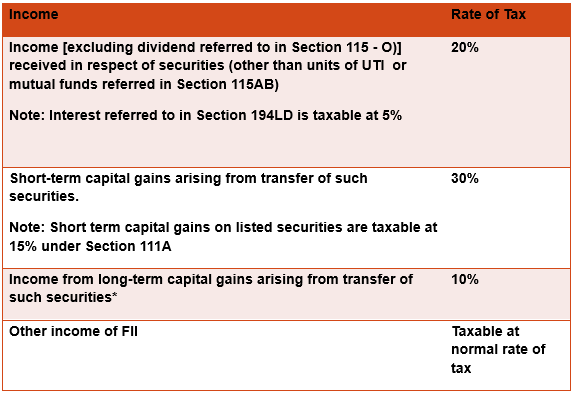
*Long term capital gains arising from transfer of long term capital asset being equity shares of a company or a unit of equity oriented fund or a unit of business trusts, was exempt from income-tax under clause (38) of section 10 of the Act in the hands of the FII. After the withdrawal of exemption of long-term capital gains on equity shares, units, etc. u/s 10(38), such long-term capital gain on equity shares or equity oriented mutual funds will become taxable in the hands of FIIs as well u/s 112A, provided such gains exceed one lakh rupees and other conditions of Section 112A are satisfied .
EXAMPLE:-
Foreign Institutional investor has earned long-term capital gains of Rs 1,50,000 during the PY 2017-18 on income arising from transfer of listed equity shares. In this case, exemption would be available u/s 10(38) as amended provision of Section 115AD of Income tax act is applicable from AY 2019-20.
EXAMPLE:-
FII has earned long-term capital gains of Rs 90,000 during the PY 2018-19 on income arising from transfer of listed equity shares. In this case, exemption u/s 10(38) would not be available. However, FII is not liable to pay tax on long-term capital gains up to Rs 1,00,000.
EXAMPLE:-
FII has earned long-term capital gains of Rs 2,00,000 during the PY 2018-19 on income arising from transfer of listed equity shares. In this case, exemption u/s 10(38) would not be available. FII is liable to pay tax on long-term capital gains above Rs 1,00,000. Tax on such long-term capital gain comes out to be Rs 10,400 [(2,00,000-1,00,000)*10.4%].
Certain other provisions, relating to an FII who derived income by way of dividend and interest preferred above relating to the tax rates, obligation to file return of income and others are discussed as under : –
a) If the gross total income of the FII consists only of dividend and interest referred above
Where the gross total income of the FII consists only of the aforesaid dividend or interest income, no deduction shall be allowed to him under section 28 to 44C (relating to computation of taxable income under the head ” profits and gains of Business and profession”) or section 57(i) or 57(iii) (relating to computation of taxable income under the head ” income from other sources”) or under Chapter VIA.
b) If the gross total income of the FII consists income other than dividend and interest referred above
Where the gross total income of the FII consists of other incomes, then, the deduction under Chapter VI-A will be available in respect of other incomes
c) Benefit of first and second proviso to Section 48
The benefit of : –
- indexation ; and
- computation of capital gains in foreign currency,
shall not apply for the computation of long-term capital gains arising out of the transfer of long term bonds or long term GDRs.